Objects
When a Container Knows the Difference Between Open and Finished
A lab defeated all 213 tamper-indicating seals it tested, median one minute, and a new ballot-box patent rests on exactly that kind of sticker.

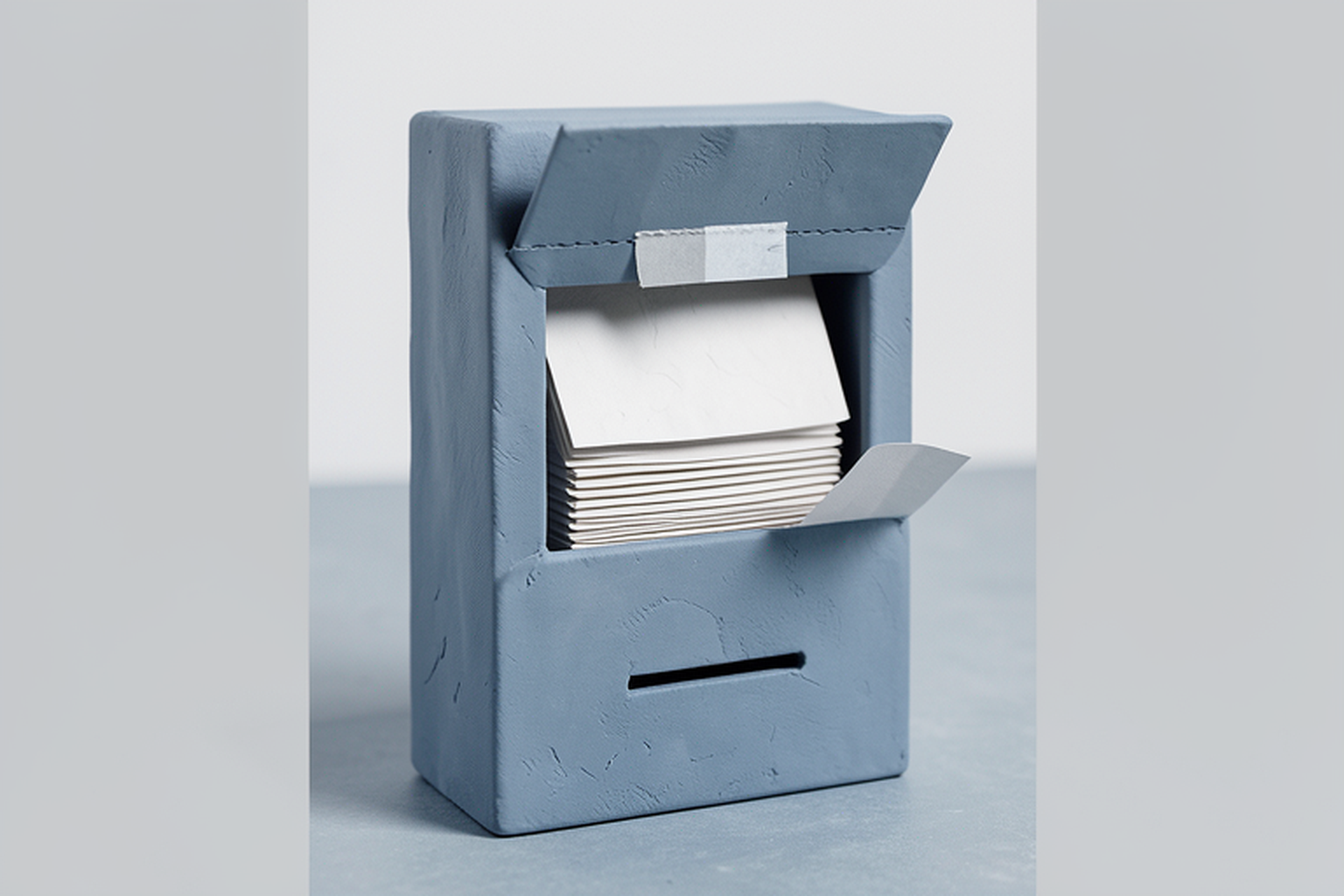
What changes in this design
At the most basic level, papers are put into a container for collection and storage. The record does not identify a usual shape or closing method.
Here, the container can be folded. It has a dedicated place for papers to go in and an enclosed space to hold them. After the papers are collected, material covers that place and the seams between parts.
This detail helps a reader picture the container's full role: papers go in first, and the entry place plus the seams are covered afterward. The record does not state what result that covering produces.
Two hundred and thirteen seals, all defeated
A team at Los Alamos National Laboratory spent years doing something plain. They bought tamper-indicating seals, the kind meant to show whether a container has been opened, and then tried to beat them without leaving a trace. Roger Johnston's group tested 213 different seals and defeated every one, using what the report calls low-tech methods, tools, and supplies available to almost anyone at low cost. Across 307 attacks, the median time to defeat a seal was one minute. The median cost was five dollars.
The figure I keep returning to is the one about price. The correlation between what a seal costs and how long it takes to beat is 0.14. Adding a dollar to the price buys, on average, under two extra seconds of defeat time. Once someone has worked out an attack, defeating the next identical seal costs 42 cents. The paper calls the word tamper-proof ludicrous. Seals have been in use for more than 7,000 years, and at least 16 percent of the ones tested were in service for nuclear safeguards.
The weakest category on the list
Johnston sorts seals into tiers, and adhesive label seals sit in the bottom one: inexpensive and easy to use, but not offering high levels of security and not especially durable. A sticker, in other words. The line that has stayed with me is shorter than that. A seal is no better than the protocols for using it. The seal isn't, to my mind, the security. Two people signing a log, a count that has to match, a custody record someone can subpoena later - that's the security, and the seal is one piece of evidence inside it.
A cardboard box, filed in April
Which brings me to a filing published on 27 August 2026, titled Secure Document Collection and Storage Container. The title is generic enough to cover almost anything. The classification is not: G07C 13/02, voting apparatus. The applicant is Xerox. The opening is sized to receive ballots or test documents, the chamber is internal, and sealing material goes over the guide markings once the documents are inside.
It was filed on 8 April 2026 as a continuation of an application from 9 July 2024, four months before the general election. The stated stakes are large: preserving the trust, fairness and legitimacy of democratic processes, educational systems and licensing administrators. To my eye, the thing itself is a folded box with a sticker over the seam.
Eighteen eighty-four
Folded ballot boxes are old, and the examiner's own trail says so. A collapsible ballot box patent granted in 2005 cites prior art reaching back to filings from 1884 and 1915. Sealed seams are not new either. International election guidance has long held that lightweight cardboard boxes, sealed properly, offer no less security or transparency than boxes made of durable materials, and notes that disposable two-piece designs conventionally carry four sealing points where a durable box has two. Four seals on a cardboard box is, to me, the norm, not a departure from it. Meanwhile a Pennsylvania security-bag maker holds a 2022 patent in the identical class on a removable ballot container built to be sealed after it comes off the voting machine, from a provisional filed in 2019.
PARC left in 2023
In 2023 Xerox gave away the Palo Alto Research Center, birthplace of Ethernet, laser printing and the graphical user interface, to a nonprofit research institute, saying it wanted to focus on its own print, digital and IT offerings. For fiscal 2025 the company reported revenue of $7.022 billion, up 12.9 percent on the strength of an acquisition and down 7.6 percent without it, against a net loss of $1.029 billion. Job cuts were confirmed in October 2025 and again in February 2026, numbers and locations undisclosed both times. This application went in two months after that. I can't tell what that timing settles.
Where the risk actually sits
Drop boxes are popular where they exist. More than 40 percent of absentee and mail voters returned ballots through one, and in Washington State the share rose from 36.7 percent in 2012 to 73.1 percent in 2020. The legal ground under them shifts every session: fifteen states require them, fourteen permit them, eleven prohibit them outright, ten say nothing, and at least twenty bills touching their availability or security were live in 2026.
So my worry isn't that this box fails. It will probably do everything claimed. Canvas ballot bags already sell for about $20 and steel boxes for $104 to $220, and what vendors sell alongside them is paperwork: certificate windows, container certificates, chain of custody. That's the honest product. A sealed container reads to a watching public as proof, and the seal is the layer a determined person beats in a minute for five dollars. The risk is that it looks like an answer to distrust. It's a box.
Sources
Reporting for this piece drew on the published filing and the references below.
- Tamper-Indicating Seals: Practices, Problems, and Standards (LAUR-03-0269), Los Alamos National Laboratory
- US 6,926,155 B2 - Collapsible Ballot Box
- US 11,288,909 B2 - Secure Collection Device for Paper Ballots
- Ballot Boxes and Seals - ACE Electoral Knowledge Network
- Ballot Drop Boxes in 2024 - Stanford-MIT Elections Performance Central
- At least 10 states could change their ballot drop box laws in 2026 - Ballotpedia News
- Ballot Bags & Boxes - ElectionSource
- Xerox Holdings Q4 and FY2025 earnings release (SEC Form 8-K exhibit)
- Xerox Announces Donation of Palo Alto Research Center (PARC) to SRI International
- More layoffs confirmed as Xerox continues merger with Lexmark - WKYT
The record, briefly. US20260253471A1, “Secure Document Collection and Storage Container” The public record describes a foldable container with a document opening, an internal chamber, and sealing material covering the opening and seams after documents are collected.
More angles on this
- The Useful Quiet Room Beside MemoryAnother reading in the same Objects category on this site.
- When a Pair Does Not MatchAnother reading in the same Objects category on this site.
- A Memory Device That Treats the Edge as a Place to ThinkAnother reading in the same Objects category on this site.
- Half Width Is Not the Whole QuestionAnother reading in the same Objects category on this site.
- When a Buffer Stops WaitingAnother reading in the same Objects category on this site.
Read around this one:Public patent recordUSPTO published figure