Machines
A Cup's Separate-Place Condition
A new cup patent lands between China's cheap ice-cup boom and the smart-mug retreat, asking whether clever cooling can beat simple habits.

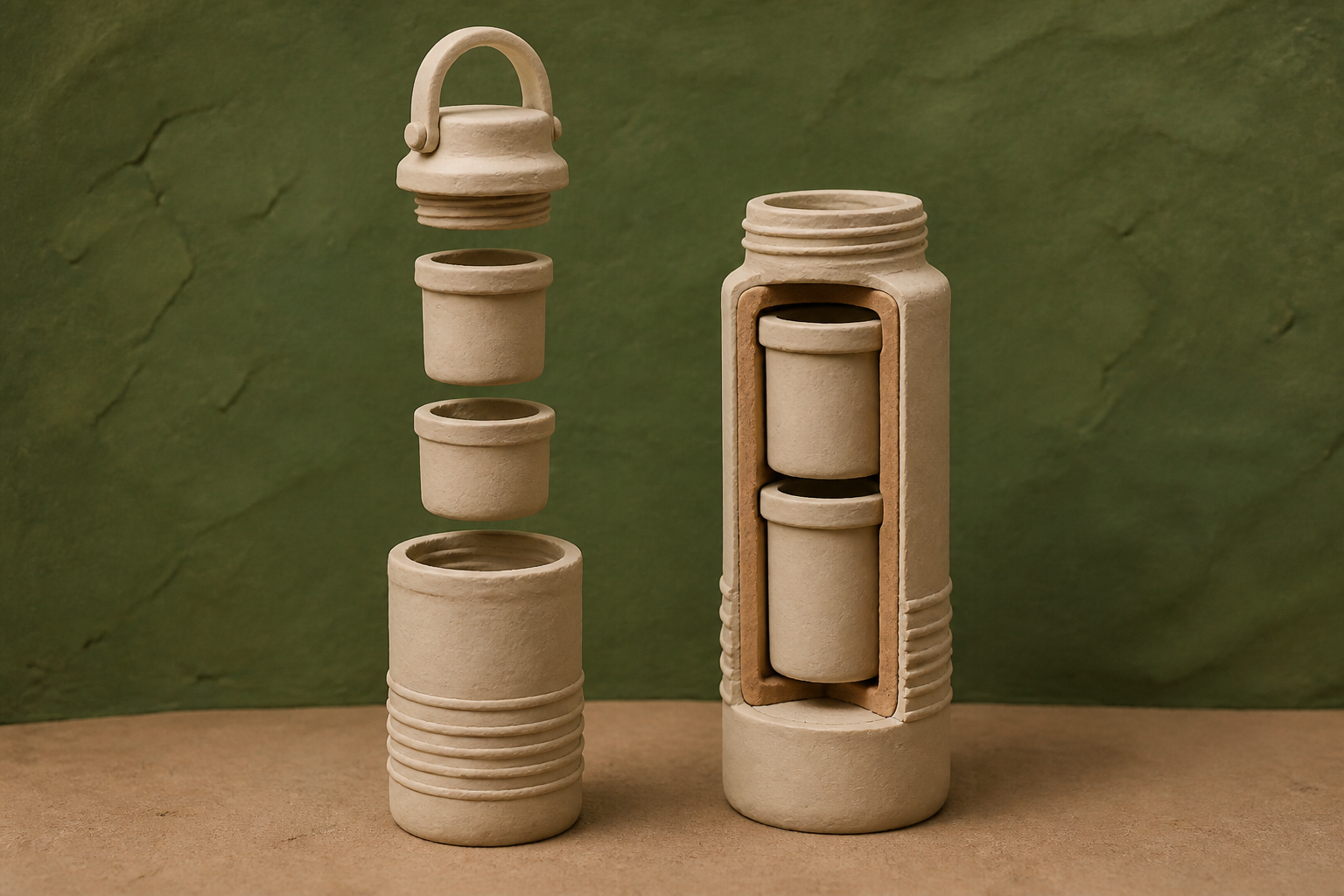
What changes in this design
A reader might expect a cup to have one main space, with its contents and anything added to influence temperature sharing that space.
Here, the cup has an outer container, a removable holder, and a threaded cover. The holder includes an insulated space for a target item and a separate storage space for temperature-regulating material.
That separation makes the idea easier to picture because the target item and the temperature-regulating material have different spaces inside the cup.
Three yuan and a cup
During China's 2024 heat wave, the most persuasive temperature-control device in many convenience stores was an ice cup. Shoppers could buy a cup of ice for 3 to 5 yuan, then build a cold drink themselves, beside cafe drinks priced at 20 to 30 yuan. One delivery platform reported a 182 percent year-on-year rise in ice-cube sales during a summer window; another account put offline ice-cup sales up 94.43 percent year on year.
Nothing in that arrangement measures a temperature or stores a proprietary material. It is cheap, visible, and replaceable, which is why the numbers made the choice look serious. The ice-cup boom matters here because it tells us what many buyers will accept: a separate cooling medium, provided it is straightforward and costs little.
One removable holder
That is the setting for US20260256318A1, Temperature-Controlled Cup. The application describes an outer container with a total accommodating chamber, a threaded cover, and at least one removable medium holder. The holder has a heat-insulation chamber for a target object and a storage space for temperature-regulating medium. In other words, it makes the removable part do two jobs at once: isolate something and carry the thing meant to change its temperature.
The design is more modest than an app-connected mug, but it is not merely a cup with a lid. What I cannot tell from these particulars is how its particular medium will perform in ordinary use. The small, physical bet is that separating the object from the medium can make temperature control more manageable. That bet is older than it first appears.
A 1997 thermal receptacle
US6634417B1 was filed in 1997 and 1998, granted in 2003, and expired in December 2019. It proposed a mug, carafe, baby bottle, or bathtub receptacle with phase-change fatty acids between a high-conductivity inner vessel and an insulated outer shell. The material was intended to pull a hot liquid down into a 120 to 154 F band and hold it there. By the time this new application appeared, the basic self-regulating-cup premise was about 29 years old.
A later US patent, filed in 2020 and granted in 2022, used three shells: a vacuum-insulation layer and a phase-change layer with a transition point around 58 C. Its description says it absorbs excess heat within 2 to 5 minutes and releases it over more than eight hours; its listed expiration is 2040. I would not treat those patents as a legal verdict on this application, because shared broad ideas are not enough to settle patentability. But they leave me skeptical of any suggestion that a chamber within a chamber, by itself, is the breakthrough.
The powered extreme
At the other end sits Ember, which has sold more than three million temperature-controlled mugs. The company raised $13 million in 2017 and $23.5 million in 2021, accumulated more than 200 granted patents, and by 2024 was moving beyond consumer drinks toward pharmaceutical cold-chain work. Its Ember Cube was described as holding 5 C for 72 hours, alongside a cryogenic shipping prototype aimed at minus 150 C.
To me, that turn is evidence of pressure rather than proof of failure. It does not establish that consumer mugs cannot work, and it is not a final judgment on anyone's business. It does show a temperature-control company taking its most demanding promises to places where temperature has a clearer consequence than whether coffee stays pleasant. The new holder-based cup occupies the space between the electronic device and the ice cup, and that middle has to earn its place in our hands.
The harder half of the problem
Temperature is only one part of the product. In January 2024, Stanley confirmed that its insulated tumblers used a lead pellet beneath a steel disc that seals the vacuum-insulation layer. A public-health agency spokesperson said the construction creates a lead-exposure risk if the disc detaches, and a lawsuit followed the next month. The details of this cup do not let me link it to lead or to a vacuum-sealed construction, and I won't imply either.
One compliance guide points to 21 CFR Part 189, which bans lead solders and tin-coated lead foil capsules from indirect food contact, and to Parts 174 through 178, which limit migration from food-contact materials. It reports no CPSC-specific drinkware standard. My concern is less the imagined peril of this filing than the mundane work it cannot make disappear: material testing, cleaning, storage, and manufacturing.
That work came back into view during the ice-cup boom, when one brand recalled 8,000 bags and more than 400 cups of shaking ice after bacterial counts failed. No patent mechanism answers that on its own. The holder in US20260256318A1 may prove useful, but the evidence here gives no reason to mistake thermal cleverness for the harder half of the problem: making a drink vessel safe, clean, affordable, and easy enough to use every day.
Sources
Reporting for this piece drew on the published filing and the references below.
- US20260256318A1 - Temperature-Controlled Cup
- US6634417B1 - Thermal receptacle with phase change material
- US11350778B2 - Temperature Control Cup
- Sales of ice cups heat up in summer
- How Ice Cups Became 2024 Summer's Hottest Profitable Business Track
- Ember's journey from hot coffee to medication transport
- Stanley Cup Lead Lawsuit: Is There A Lead Poisoning Risk?
- Stainless Steel Drinking Bottle Regulations in the US
The record, briefly. US20260256318A1, “Temperature-Controlled Cup” A temperature-controlled cup includes an outer container with a total accommodating chamber, a threaded cover, and at least one removable medium holder having a heat-insulation chamber for a target object and storage space for temperature-regulating medium.
More angles on this
- A Coffee Basket's Quiet Second ActAnother reading from the same A47J classification family, kitchen equipment; coffee mills; spice mills; apparatus for making beverages.
- CPC A47J: Kitchen equipment; coffee mills; spice mills; apparatus for making beveragesThe official classification family this record was filed into, published in the USPTO Cooperative Patent Classification scheme.
- A Beverage Package and the Evidence Before ActionAnother reading from the neighbouring A47G classification family, household or table equipment.
- Accessory And Drinkware Assemblies: The Choice After ConnectionAnother reading from the wider A45C classification family, purses; luggage; hand carried bags.
- Two Rolling Brushes, Mirrored: A Cleaning Module That Says Which Way Its Bristles FaceAnother reading in the same Machines category on this site.
Read around this one:Public patent recordUSPTO published figure