Machines
A Small Bond, a Better Exit
A hard drive is sealed for life, so Seagate is taking the glue out of it and putting in the tin alloy NASA blames for whiskers.

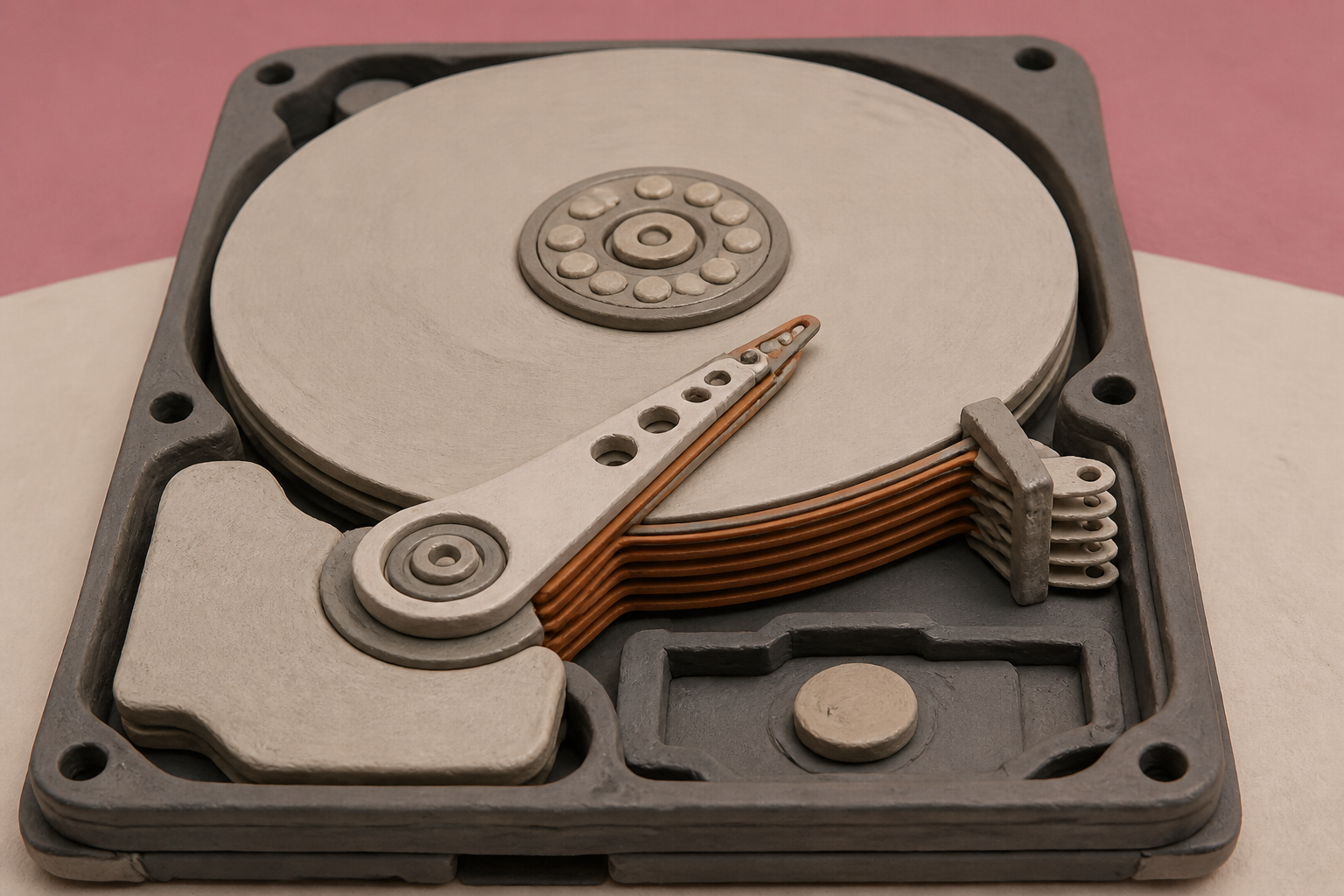
What changes in this design
The two pieces could be fastened with adhesive or epoxy. Inside the hard drive's enclosure, those materials can release gas, which this invention seeks to avoid.
Instead, the end portion of the trace gimbal assembly is fastened to the head stack arm assembly with one or more small spots of solder.
That matters because it avoids the adhesive-or-epoxy gas issue inside the enclosure while leaving a solder bond that can be reworked.
Nanometers, 400 degrees, no way back in
The read head in a high-capacity drive flies over the platter at a height measured in single-digit nanometers. Under it, in the newest drives, a small optical device heats one spot on an iron-platinum film past 400 degrees Celsius and lets it cool, all inside roughly a nanosecond. That is heat-assisted magnetic recording, and it exists because the magnetic grains have to be too stable to flip on their own at room temperature.
The whole assembly lives in a sealed enclosure. I can't ignore the finality. Nobody opens it. There's no service port, no filter change, no cleaning. Whatever is inside on the day the lid goes on stays inside for the life of the drive, a few nanometers from a surface being flash-heated by a laser.
Twenty years of epoxy nobody flagged
Inside that box, a thin flexible circuit runs down the actuator arm and carries signals to the head. Its tail has to be physically fastened to the arm. For a long time the standard move was a dab of adhesive.
Western Digital's own patents describe it, to my surprise, without ceremony. A 2016 filing on flexure-tail design calls it adhesive tacking and names epoxy as the material, listing the electrical attach options separately: ultrasonic bonding, solder reflow, solder ball jet, anisotropic conductive film. An earlier one, filed in 2005, works through laser-reflowed solder bumps and worries about stacking tolerances leaving some pads touching and others not. Neither says a word about contamination or outgassing. The glue simply wasn't a problem worth raising.
One tack, and nothing else holding it
Seagate filed on February 24, 2025, and the application published on August 27, 2026. The background states the motive flatly: acrylate-based adhesives contain organic materials that can outgas inside an enclosed drive environment, "such as found in heat-assisted magnetic recording (HAMR) HDDs." The fix is to delete the adhesive, as I read it.
Claim 1 specifies a lead-free alloy of 3 to 4 percent silver, 0.5 to 0.7 percent copper, and the balance tin. Claim 21 goes further, requiring that solder be the only material bonding the tail between the upper and lower parts of the arm. There's a second benefit the filing is candid about: cured epoxy is permanent, and a solder tack can be melted and redone.
More heads per drive, more joints to scrap
Rework matters more than it sounds, I think. Seagate's last fiscal year came in at $12.2 billion, up 34 percent, with a record gross margin above 52 percent and the vast majority of its nearline capacity already committed into calendar 2028. Unit shipments were flat. The growth came from packing more platters and more heads into the same box, up roughly 15 and 20 percent per drive.
Every extra head is another one of these joints. Scrapping a nearly finished arm assembly over one bad bond is expensive, and the suspension parts involved come from a supply base concentrated enough that prosecutors secured guilty pleas over price-fixing in it in 2019.
What NASA says about high-tin solder
Here's what nags at me: I worry about the tin. NASA's electronic parts program is blunt about tin: alloying it with lead imparts whisker-inhibiting properties, and tin-lead with at least 3 percent lead is considered acceptable. Lead-free, tin-rich finishes are the whisker-prone family.
Whiskers are conductive crystals a few microns across that grow out of the surface on their own, typically several millimeters long and sometimes past ten, at rates from 0.03 to 9 millimeters a year, after a dormant period that can run from days to years. NASA attributes at least three total on-orbit failures of commercial satellites to whisker-induced shorts, plus failures in medical devices and power plants, and points at the European restriction that took effect in June 2006 as what pushed manufacturers toward pure tin. The claimed alloy here is about 95 to 96.5 percent tin.
The open question
I don't offer that as a gotcha. Whisker growth depends on stress, plating chemistry, temperature and geometry, and a reflowed solder joint isn't a bright tin plating. The regulatory pressure is real too. European regulators have kept narrowing the carve-outs for leaded solder, and the current high-lead exemptions are set to lapse at the end of 2027, so a 2025 filing specifying lead-free isn't a free choice.
Still, the trade is worth stating plainly. An environmental rule and a density race are meeting inside a cavity that by design can never be opened or cleaned, and the answer is to take the organic material out and put more tin in. What I'd want to know, and what the filing doesn't say, is how long they aged one of these joints before they were satisfied.
Sources
Reporting for this piece drew on the published filing and the references below.
- US9564156B1 - Head gimbal assembly having a flexure tail with cover layer standoff islands
- US7414814B1 - Compliant suspension tail design for solder reflow
- Basic Info on Tin Whiskers - NASA Electronic Parts and Packaging Program
- AI storage boom is keeping Seagate's hard drives spinning
- Final Delegated Directives for Key RoHS Lead Exemptions Adopted
- HAMR Hard Drives: Increasing Data Density and Drive Capacity
- Plaintiffs File Amended Complaint in Hard Drive Component Antitrust Suit
The record, briefly. US20260253610A1, “Solder Tack Bonding Of Hard Disk Drive Actuator Arm Assemblies” Actuator assemblies for hard disk drives and methods of making them use one or more solder tacks to fasten a trace gimbal assembly tail to a head stack arm assembly, avoiding adhesive or epoxy outgassing inside the enclosure while allowing the solder bond to be reworked.
More angles on this
- A Stationary Pivot, a Moving ArmAnother reading of a record filed by the same applicant, Seagate Technology LLC.
- Why a Deliberately Weaker Signal Can Make a System More HonestAnother reading in the same Machines category on this site.
- The Small Condition in a Memory Core's GeographyAnother reading in the same Machines category on this site.
- A Small Committee Before StressAnother reading in the same Machines category on this site.
- The Doorbell Before the ParcelAnother reading in the same Machines category on this site.
Read around this one:Public patent recordUSPTO published figure