Machines
A Stationary Pivot, a Moving Arm
The voice coil motor has gone unchanged since the early 1980s, and a filing dated six weeks before China's rare earth controls proposes replacing it with friction.

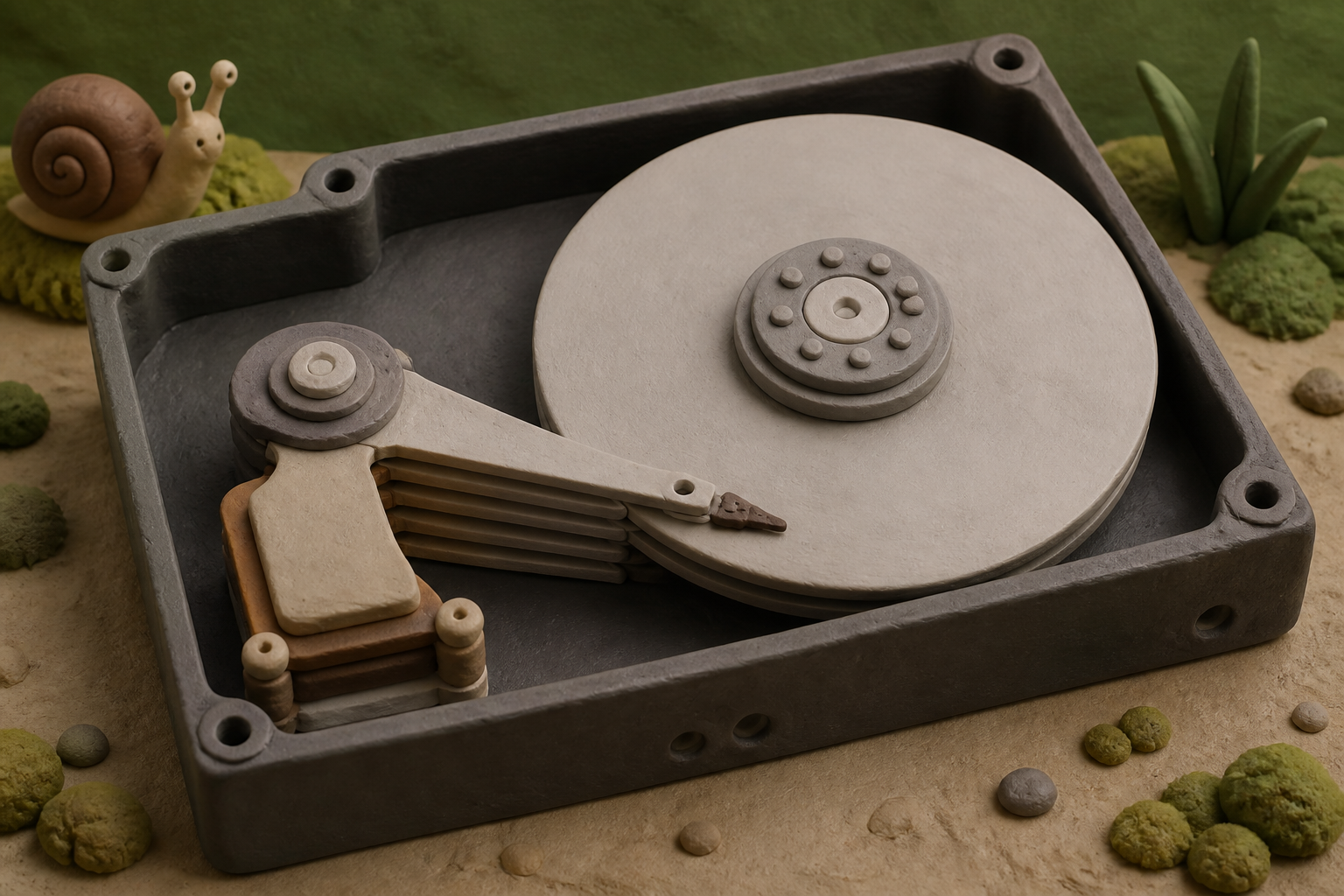
What changes in this design
Without more detail, a reader might picture a hard disk drive with a recording head associated with a movable arm. The record does not set out a conventional motor system for comparison.
Here, piezoelectric motors rotate the actuator arms, and the hard-disk actuator assemblies are arranged around a stationary pivot.
The fixed point and the moving arm have different roles: one stays in place, and the other is rotated by the motor. That is the concrete relationship the record establishes, without stating a result or advantage.
Seven elements and a six-week gap
On 8 April 2025 China placed export controls on seven rare earth elements: samarium, gadolinium, terbium, dysprosium, lutetium, scandium and yttrium. The country holds roughly 70% of global mining output and about 87% of refined supply. Three of those seven, dysprosium, terbium and scandium, get described as irreplaceable in the high-performance magnets hard drives depend on. Sanchit Vir Gogia, who runs an IT research firm, put the difficulty plainly: "What elevates the severity is the lack of short-term substitutability. Unlike chips or cables, these elements can't simply be redesigned out of a supply chain."
Six weeks before that, on 24 February 2025, Seagate filed an application that tries to do exactly that redesign. It published on 27 August 2026 as US 2026/0253609 A1, and it names rare earth magnets as a design burden in its own text. Before the controls, not after. That sequence is why I read it twice.
The motor nobody had reason to change
Inside a hard drive, a voice coil motor swings the arm carrying the read/write heads. It's a coil sitting in a magnetic field, no contact anywhere, and the arrangement has been settled since the early 1980s. The filing's complaint is blunt: these motors "can be quite bulky, take up a fair amount of space within the HDD housing" and "require the use of rare earth magnets."
Space is scarcer than it was. Drives with two independent actuators have shipped since 2019; one 14TB model reached 524 MB/s sustained transfer against 261 for its single-actuator sibling, and 304 read IOPS against 170. The doubling cost something, though. That drive presents as two logical 7TB units. Capacity climbs anyway: 44TB drives are in volume production, on a roadmap toward 100TB. More platters means more heads and more arms, and the filing says multi-actuator designs "have required space for additional VCM actuator leads and other components, and/or have required a reduction in the number of media disks."
Inchworm, brake crawler, ultrasonic
The proposal is to remove the magnets and turn the arms with piezoelectric motors instead, materials that deform under voltage, coaxed into rotation. Claim 1 turns a whole stack of actuator assemblies around a single stationary pivot as one unit. Claim 10 turns one assembly of that stack on its own. Claim 12 puts several piezo motors in two vertically aligned stacks at different points around the pivot. Three candidate mechanisms are named: inchworm motors, brake crawler motors, and ultrasonic motors.
None of this arrives from nowhere. A patent granted in October 2022 already used an ultrasonic piezo element inside a drive: a finger driven above about 60 kilohertz, pressing on a curved surface to swing a suspension through roughly 17 radial degrees on a 0.25 mm ball bearing. There the piezo was a second stage, fine trim sitting on top of the voice coil. The new filing promotes the same physics to primary drive. That is the whole leap.
Two nanometers above the platter
Here is what bothers me. A modern head flies at an active magnetic spacing of one to two nanometers. Under it sit a one-nanometer lubricant layer, a two to three nanometer carbon overcoat, then the recording layer at ten to twenty. Any particle taller than the fly height launches the slider off its equilibrium, and one head crash on one surface makes enough debris to contaminate every surface in the drive, each landed particle becoming a fresh bump.
Cleanroom motion-control guidance ranks mechanisms by how much they shed. Plain bearings, sliding surface against surface, are rated unsuitable. The standing advice is to use direct drive linear motors and eliminate drive-mechanism particles entirely. A voice coil motor is already that: non-contact, electromagnetic, direct. An ultrasonic piezo motor is a stator pressed against a rotor and turned by friction. A 1998 review established that this contact governs speed, torque, power, efficiency and wear life, and closed on open questions. Wear life is still the governing unknown.
The rival that recycled instead
Western Digital met the same squeeze twice, and both answers point away from this one. Nine days after the controls took effect it described recovering rare earths from end-of-life drives with partners: about 50,000 pounds of material processed, roughly 90% elemental recovery, 95% less carbon than virgin mining, neodymium and dysprosium and praseodymium coming back out. Reclaim, not eliminate. Then in February 2026 it described a dual pivot design adding a second actuator set on a separate pivot, the exact opposite of one stationary pivot, claiming up to four times the bandwidth cumulatively. In the lab now, available 2028.
Where this leaves things
The market makes this a hard sell. Nearline capacity is allocated deep into 2028, datacenter demand is around 90% of exabytes shipped, and unit volumes are flat while exabytes grow 15 to 20%, so every bit of growth rides on capacity per drive. Nobody buying at that scale wants to be first to qualify a new motor.
Which is, I think, why the filing reads the way it does. It isn't a product. It's an option written down cheaply, while the option was still cheap, by people who could see what a magnet supply chain was about to become. I would bet against friction winning inside a sealed drive. I would not bet against the industry needing this drawer open.
Sources
Reporting for this piece drew on the published filing and the references below.
- Piezoelectric Motor for Hard Disk Drive Actuator Arm - US 2026/0253609 A1
- US11468909B1 - Zero skew with ultrasonic piezoelectric swing suspension
- China's rare earth export controls threaten enterprise IT hardware supply chains
- Western Digital blows hard disk drive future wide open
- Seagate Exos 2X14 HDD Delivers 524MB/s
- Seagate Delivers Industry's Highest Capacity Hard Drives with Mozaic 4+
- Giving HDD Rare Earth Elements New Life
- What Happens During a Hard Drive Head Crash
- Cleanroom Compatibility for Motion Control: A Practical Guide
- Contact mechanics of piezoelectric ultrasonic motors
- US20260253609A1 public record
The record, briefly. US20260253609A1, “Piezoelectric Motor for Hard Disk Drive Actuator Arm” The public record describes hard-disk actuator assemblies arranged around a stationary pivot and piezoelectric motors that rotate actuator arms associated with recording heads.
More angles on this
- A Small Bond, a Better ExitAnother reading of a record filed by the same applicant, Seagate Technology LLC.
- Why a Deliberately Weaker Signal Can Make a System More HonestAnother reading in the same Machines category on this site.
- The Small Condition in a Memory Core's GeographyAnother reading in the same Machines category on this site.
- A Small Committee Before StressAnother reading in the same Machines category on this site.
- The Doorbell Before the ParcelAnother reading in the same Machines category on this site.
Read around this one:Public patent recordUSPTO published figure