Field Notes
Fermented Milk Makes the Next Move Easier to See
Meiji's new fermented-milk filing shows why protein drinks live or die by texture, even as the business case grows less certain.

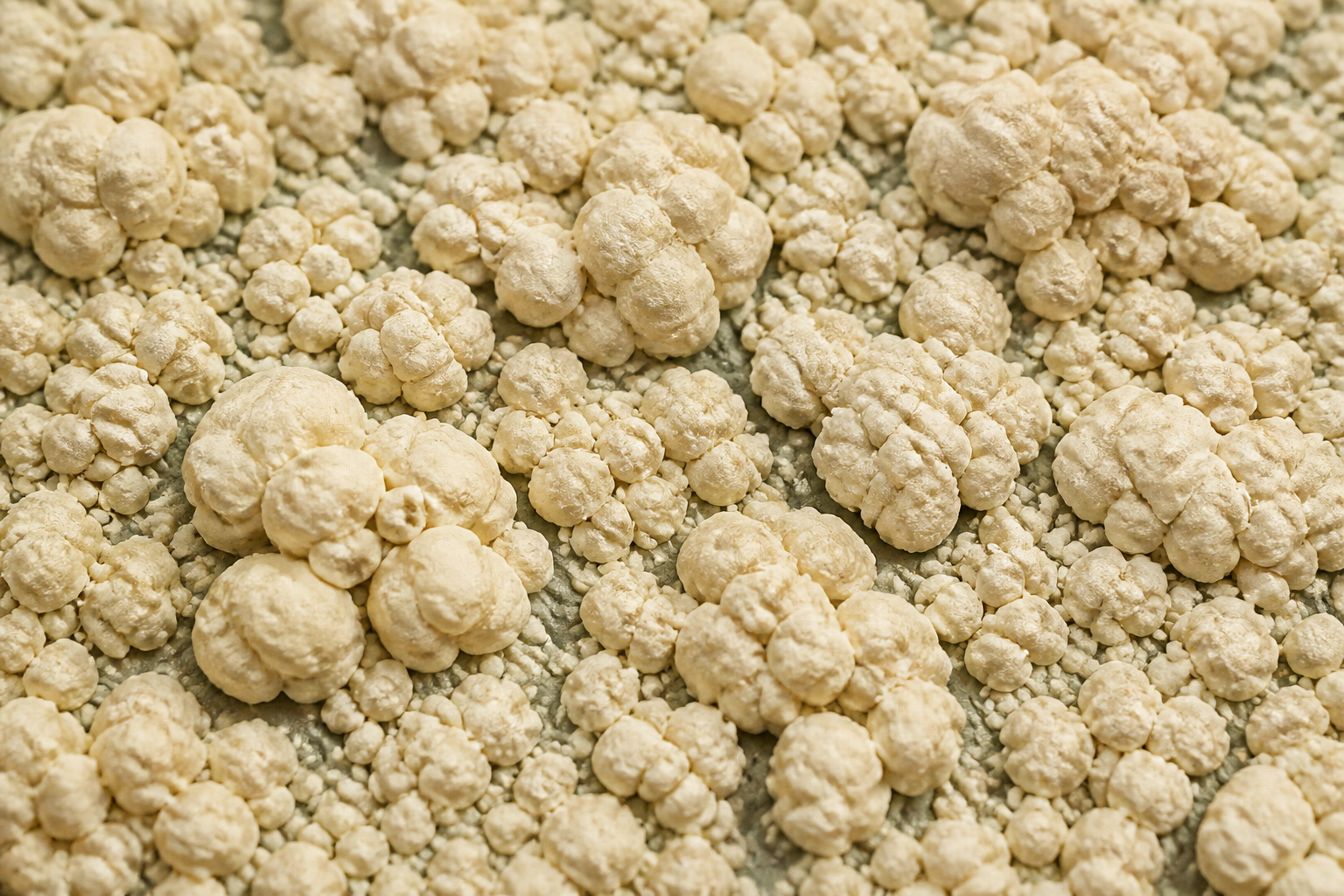
What changes in this design
Without this added detail, a reader would only know that the item is fermented milk. No usual recipe, production method, or standard particle shape is stated.
This entry focuses on protein particles within the fermented milk. Their average aspect ratio, meaning a comparison of length and width, ranges from 1.0 to 1.8.
That number identifies a physical feature of the product: the overall proportion of its protein particles. It does not state an effect on taste, texture, nutrition, manufacture, or use.
¥7.6 billion and a sale
On August 5, 2026, Meiji reported ¥22.6 billion in quarterly operating profit, up 27.7 percent from a year earlier. In the same results, it announced a sale of its loss-making China dairy and yogurt operations for about ¥7.6 billion. The contrast gave me pause. A strong quarter can coexist with a retreat from a business that is expected to remain in the red.
Twenty-nine days later, on September 3, a US publication called Fermented Milk appeared with Meiji as applicant. The timing isn't, to my mind, proof of a corporate plan, and the filing names no retail product. But it is evidence of a stubborn fact: protein is easy to promote, while making a protein-heavy fermented drink feel good in the mouth takes technical work.
September 3, 2026
The filing is narrow in a revealing way. It claims protein particles with an average aspect ratio from 1.0 to 1.8, alongside circularity of at least 0.6. That reads to me as a preference for particles that are not markedly elongated. The claims also require at least 10 percent protein by mass and viscosity no higher than 5,000 mPa·s at 10°C. That is a tightly defined compromise, not a broad claim that every high-protein yogurt will taste better.
Why focus on shape? The filing describes what happens after curd-breaking: during storage, proteins can reaggregate, rebuild a network, and drive viscosity upward. Its proposed process ferments and cools the mix while allowing it to flow, in an effort to suppress network formation and produce more spherical particles. The publication leaves me unable to tell how a finished drink tastes or whether the process scales well. Storage stability, not just the first spoonful, is central to the claim, as I read it.
Three microns and forty-five years
An earlier Meiji patent makes this look less like a sudden discovery than a long-running effort. Filed in 2018 and granted in 2022, it tackled soft yogurt's choice between graininess and a thin, watery result. It used at least 25 percent whey protein, homogenization, and a 20 to 50°C re-gelation hold to make particles 3 to 30 micrometres across. That work emphasized size and processing. This one brings geometry forward.
A still older precedent I found is Simplesse, a microparticulated-protein technology developed between 1979 and 1984. Its small rounded protein particles were intended to give foods a fat-like creamy feel. That history does not show that Meiji copied anything, and this filing is tuned to shape rather than size alone. It does show why I take particle geometry seriously: we have known for decades that protein's physical form is part of texture, not merely nutrition.
A 32-gram drink in Thailand
That technical work sits beside a real product launch. In November 2025, a Thai Meiji joint venture introduced a pasteurized skim-milk drink with 32 grams of protein, type II collagen, and 5,758 milligrams of BCAAs. That drink is not one I would tie directly to this US filing. The material I read does not establish that link. But both point to the same consumer test: as protein rises, the drink has to remain pleasant enough to buy again.
One market forecast estimates the global high-protein yogurt category at $45.4 billion in 2026, with 7.9 percent annual growth projected through 2036. That is, in my view, a forecast, not a settled measurement, but it helps explain why texture patents matter. Spoonable products hold the larger share; drinkable products are roughly a third. The filing's viscosity limit and its flowing fermentation process speak most directly to that drinkable problem.
The harder half of the problem
Still, a particle specification is not something I would treat as a guarantee of pleasure. Research on oral texture perception found that a person's pressure sensitivity helps determine whether they notice particle size and grittiness. A rounded particle that seems smooth to one person may not register the same way for another. The filing addresses the food's physical structure. It cannot settle the variation in the mouths that receive it.
The label brings a second limit. A legal review describes US challenges to high-protein food claims, including disputes over nitrogen-based protein calculations and digestibility. It counts 325 food and beverage class actions filed in 2021 and says courts have often dismissed protein-label cases on federal-preemption grounds. Meiji's filing represents, in my view, serious food engineering, not a finished consumer promise. Rounder particles may help a high-protein drink hold together. Trust will depend on taste, labeling, and what real people perceive after the bottle is opened.
Sources
Reporting for this piece drew on the published filing and the references below.
- US20260256160 - Fermented Milk
- JP7178789B2 - Fermented milk and its manufacturing method
- Simplesse
- Meiji Holdings FY2026 Q1 Earnings Call: Operating Profit of ¥22.6 Billion, Up 27.7%
- CP-Meiji launches High Protein Activ in Thailand
- High Protein Yogurt Market Size, Trends & Forecast 2026-2036
- Sensing food textures is a matter of pressure
- Food Labeling Litigation Trends: Protein
The record, briefly. US20260256160A1, “Fermented Milk” The fermented milk contains protein particles, and the average aspect ratio of those particles is from 1.0 to 1.8.
More angles on this
- Method For Producing Fermented Milk Makes the Next Move Easier to SeeAnother reading from the same A23C classification family, dairy products, e.g. milk, butter or cheese; milk or cheese substitutes; preparation thereof.
- CPC A23C: Dairy products, e.g. milk, butter or cheese; milk or cheese substitutes; preparation thereofThe official classification family this record was filed into, published in the USPTO Cooperative Patent Classification scheme.
- The Judgment Space Between Washing and PackagingAnother reading from the neighbouring A23B classification family, preservation of foods, foodstuffs or non-alcoholic beverages; chemical ripening of fruit or vegetables.
- A Baked Product's Specified Sugar RelationshipAnother reading from the wider A21D classification family, treatment of flour or dough for baking, e.g. by addition of materials; baking; bakery products.
- Oat Flour's Next Pair of HandsAnother reading in the same Field Notes category on this site.
Read around this one:Public patent recordUSPTO published figure