Machines
When a Filter's Openings Refuse the Centerline
Has Element Material and Longitudinal Axis form one stated connection: A filter element has element material between two end caps.

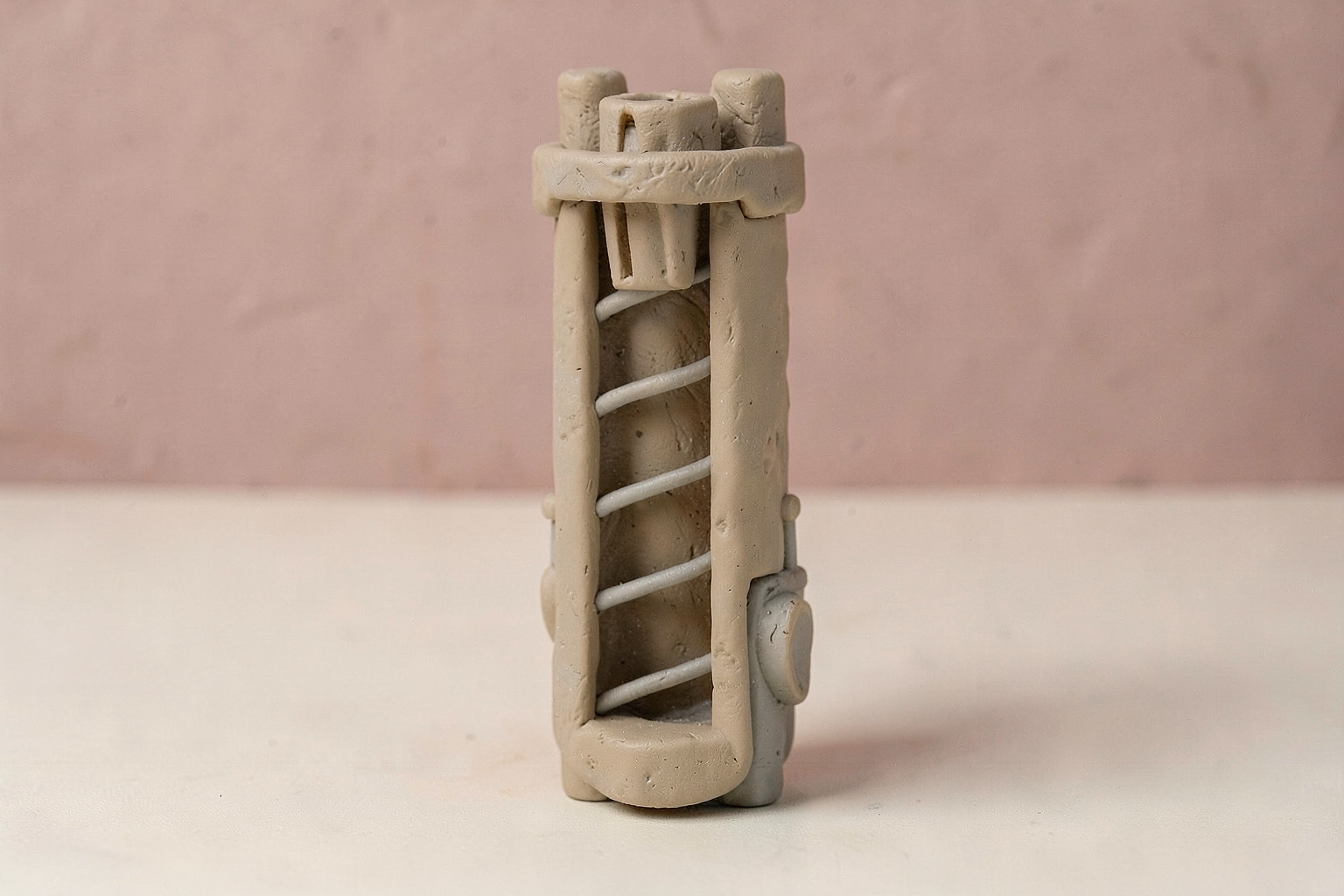
First, the setting
Homes, workshops, vehicles, and water systems all move air, fuel, oil, or water through equipment. Tiny bits of dust, grit, or debris can travel with those fluids and collect where they are unwanted. People use filters because keeping those materials apart helps everyday machines and systems stay cleaner and easier to maintain.
A maintenance worker may open a metal housing in a vehicle, a building service room, or beside industrial equipment. Inside is a fitted filter cartridge held between end pieces, while air or liquid moves through the housing. Nearby users may simply notice a vehicle running, water flowing, or ventilation circulating through a familiar space.
What changes in this design
A reader might picture a long filter part with fluid openings aligned with the middle line running lengthwise through it.
Here, the inner passages in both the receiving part and connecting part are offset from the lengthwise centerline. The step between those parts also has an opening for fluid passage.
It makes clear that the passage layout is not centered from end to end. The step is also part of the fluid route, not merely a change in shape. What effect this layout has is not stated.
Off-center openings
Element material lies between two end pieces. The openings inside the parts that receive and connect are set off the element's lengthwise middle. That is the concrete moment that opens US20260263970A1, published September 10, 2026, under the title Filter Element And Filter Device. What I noticed first was not an outcome but a visible relationship to a middle. The eye gets a simple task before any grand interpretation: find that middle, then notice that the specified openings do not meet it. The arrangement has the air of a stage manager who has moved the entrance one pace to the side and left the audience to notice. You do not need a grand theory to see the choice. The placement is described in relation to the middle, and it is not on it.
That off-center choice made me look twice because the pattern extends beyond a single hole. The filing describes two parts with inside openings through which fluid can pass. Each opening sits away from the imagined middle that runs along the element. Between the two parts, a change in position also contains its own opening. The detail does not ask you to imagine a perfectly centered channel and then ignore it. Instead, the picture contains a middle line, sideward openings, and a change between parts that itself includes an opening. That repetition is why the arrangement reads as a relation, not as a stray measurement. It is less like a door drawn on the middle of a wall and more like a door placed deliberately beside its frame.
The offset step
That carry-through is the consequence worth naming before the larger lesson: placement is not background decoration here, but part of the stated arrangement. The patent supplies the more formal names now. End caps are the two end pieces between which element material lies; the receiving part and connecting part are the two named parts; inner through-openings are openings inside them for fluid passage. The longitudinal axis is the imagined line running lengthwise through the element. An offset step is the named change in position between the parts, and it too has a through-opening. These terms make the modest purpose visible: to specify the openings and their relative positions in a filter element and filter device. Nor do the facts considered here establish why the openings are offset, or what outcome might follow. The offset step has the air of a patient clerk, keeping the sideward detail on its clipboard. Names do not turn a setting into a promise.
Settings and promises
That restraint makes the difference between a setting and a promise easier to see. A setting tells you where components sit and how their openings relate to a reference line; a promise would tell you what benefit follows from that placement. The published details give the former in the facts at hand, while the latter is not supplied. This is no deficiency in the arrangement; it is a boundary on what you and I can responsibly infer from its description. An ordinary version of this task might mention that a filter has passages and leave their placement as unimportant scenery. This filing does not leave that placement unmarked. It ties the opening positions to the axis and includes the intermediate step in the picture. One relationship becomes visible: the longitudinal axis and the inner through-openings are no longer presumed to coincide. It resembles a label-maker printing offset rather than better, and that is more exacting than it sounds.
From that contrast, two transferable observations emerge for you whenever a design, a diagram, or a system description seems ordinary at first glance. A reference line is not mere scenery: it creates the relationship that lets an offset become legible. In practical reading, ask what position is being used as the reference before deciding what a sideward placement means. That question is concrete: a longitudinal axis here provides the reference against which the openings are described as offset. A transition also deserves its own attention. When a configuration moves from one alignment to another, note whether the change is explicitly represented instead of disappearing in the gap between labels. Here, the offset step is explicitly represented with a through-opening. Those habits do not turn this arrangement into a sweeping lesson about results; they keep you attentive to what is actually set out and to what has not been established.
That attention folds back to the detail at the beginning: element material between two end caps; inner through-openings in the receiving and connecting parts displaced from the longitudinal axis; and another through-opening in the offset step between the parts. I think that return is the durable value of this small arrangement. It leaves you with a setting you can picture rather than a promise you have to supply yourself. Nothing in the supplied facts calls for decorating that setting with an unclaimed result, and nothing is lost by letting the geometry do the speaking. The physical detail remains less like a straight hallway that happens to have side doors and more like a route whose side doors ask to be noticed. The line stays in the middle; the described openings do not. That is the first concrete detail again, and it is still doing the work.
The record, briefly. US20260263970A1, “Filter Element And Filter Device” A filter element has element material between two end caps, with receiving and connecting parts whose inner through-openings for fluid passage are offset relative to the longitudinal axis; an offset step between the parts also has a through-opening.
More angles on this
- The Small Correction Inside a Roller-Brush Cleaning RoutineAnother reading from the same B01D classification family, separation.
- Inside exhaled breath capture modulesAnother reading from the same B01D classification family, separation.
- CPC B01D: SeparationThe official classification family this record was filed into, published in the USPTO Cooperative Patent Classification scheme.
- Exhaust Gas Purification Catalyst Device Treats the Relationship as the PointAnother reading from the neighbouring B01J classification family, chemical or physical processes, e.g. catalysis or colloid chemistry; their relevant apparatus.
- One Thread Between Two RidesAnother reading from the wider B62J classification family, cycle saddles or seats.
Read around this one:Public patent recordUSPTO published figure