Field Notes
Where the Seed Disc Handoff Comes Into View
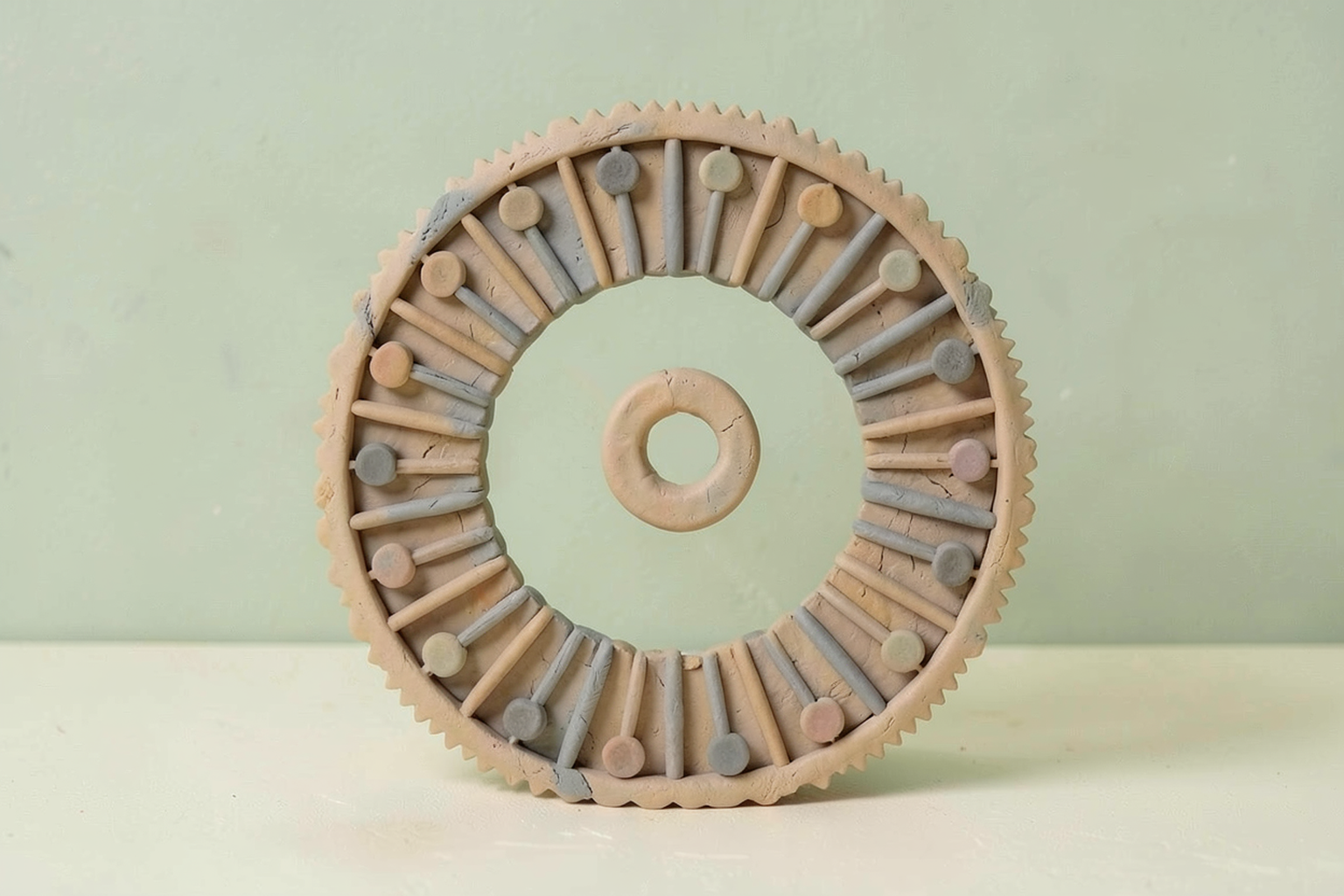
Follow Example Seed Disc alongside Key detail: Seed discs, seed meters including the seed discs. It keeps the central design choice visible.

First, the setting
Growing food often starts with placing seeds into prepared soil. Farmers and gardeners care about where seeds land because crowded, uneven, or missed spots can make later work harder. Planting equipment helps turn a large, repetitive task into a steady pass across a field.
In a field, an operator drives a tractor pulling a planter across dark, worked soil. Inside the planter, a rotating disc carries seeds through small openings as the machine moves. Behind it, soil closes over the planting path, leaving orderly rows that soon look like simple lines across the ground.
What changes in this design
The record does not explain how seed meters ordinarily handle seeds, so it does not establish a usual design or routine.
Here, the focus is a plate containing multiple seed receptacles. Each receptacle has an aperture around its outer edge and one or more supports within the opening.
That makes the small internal features visible. The invention concerns not only a planter as a whole, but also a disc used inside a seed meter.
Openings, Edges, and Supports
Because a plate holds multiple seed receptacles, each with an outer edge that defines an aperture and one or more supports within it, the effect is a handoff worth separating into roles; the next choice is whether you read the arrangement as one vague opening or as a sequence. The patent gives only a compact picture, yet that picture is enough to slow the eye: a plate, repeated receptacles, openings bounded by their outer edges, and supports inside those openings. The plate and its receptacles have the air of a stage manager setting small places before anyone crosses the floor. That is what made me look twice, not because the published record promises drama, but because it places boundaries and supports together where a casual glance might see only holes. The important condition is not motion observed or result claimed; it is the coexistence of these elements in the description.
To make that first choice responsibly, the terms need ordinary meanings. A seed disc is the plate described in the patent, and a seed receptacle is one of the multiple places formed in that plate for seed. An aperture is the opening whose outer edge is defined by the receptacle, while a support is the one or more elements the filing locates within that aperture. The aperture looks less like an empty hole and more like a labeled doorway with its boundary already on duty. I noticed that this vocabulary is modest but precise: it asks you to distinguish the edge from what lies inside, before drawing any larger conclusion. That distinction keeps the sentence from collapsing the frame and its contents into a single unnamed feature.
With the names in place, the mechanism can remain both simple and bounded. The filing describes multiple receptacles on a plate; for each, an outer edge defines an aperture, and one or more supports are within it. Read in that order, the layout supplies a three-beat test: locate the receptacle, identify the aperture boundary, then notice the support inside. Inside it, the one or more supports wait as if a restrained committee had taken their seats before the agenda arrives. Cause is the stated arrangement; effect is the clearer question it creates; the practical test is whether the reader can point to each role without merging them. The sequence matters here because it turns a broad visual impression into a checkable relationship among parts, without pretending that the published record tells us more than it does.
Disc, Meter, and Planter
That three-beat test also explains why the filing's stated scope is wider than a plate viewed alone. Seed discs, seed meters including seed discs, and planters including the seed meters and seed discs are all provided in the published record. The title, Seed Discs For Use With Seed Meters And Planters, published September 10, 2026, as US20260262560A1, directs attention across those nested roles. A disc is one part, a seed meter is a part that includes the disc, and a planter is described as including the seed meter and disc. That expansion is not an invitation to infer how any piece behaves; it is a reminder that the named arrangement lives at more than one level. That is the purpose worth holding onto: map the arrangement before making the handoff into a story.
A Defined Answer to Guesswork
That stated scope gives the comparison a fair boundary. An ordinary look at a disc could invite a guess that the opening is the whole story, as if a label-maker had put one tag on a cabinet and called the shelves explained. This filing offers a defined response in place of that guess: distinguish the receptacle, the outer edge that defines the aperture, the support or supports within it, and the larger nesting of disc, meter, and planter. The response has a useful order: describe first, compare second, and reserve conclusions for what is actually stated. The contrast is not a claim about superiority or outcome. It is a disciplined way to ask what belongs to which role before you explain a transfer.
That is the transferable consequence I think you can use elsewhere. First, when a system seems to move something from one part to another, look for the boundary that names the handoff instead of assuming the visible gap explains itself. Second, when several assemblies are named together, test the nesting order before treating them as loose companions: disc as included by meter, and meter and disc as included by planter, as the published record describes. These are small habits, but they replace a guess with a sequence you can inspect. You do not need a grand system to apply it; a form, a queue, or a checkout can all be read by asking where one role stops and another begins. The plate, aperture, and support thus leave a modest lesson: when timing is hard to see, assign each part its place and let the handoff become legible.
The record, briefly. US20260262560A1, “Seed Discs For Use With Seed Meters And Planters” Seed discs, seed meters including the seed discs, and planters including the seed meters and seed discs are provided. An example seed disc includes a plate with multiple seed receptacles, each having an outer edge defining an aperture and one or more supports within it.
More angles on this
- Where Pressure Meets the Turning ElementAnother reading from the same A01C classification family, planting; sowing; fertilising.
- The Seed Method's Extremely Serious Fresh StartAnother reading from the same A01C classification family, planting; sowing; fertilising.
- CPC A01C: Planting; sowing; fertilisingThe official classification family this record was filed into, published in the USPTO Cooperative Patent Classification scheme.
- The Boundary Inside Smart Pet MonitoringAnother reading from the neighbouring A01K classification family, animal husbandry.
- Foldable Solar Panel: Folding as a Signal for AttachmentAnother reading from the wider A45F classification family, travelling or camp equipment: sacks or packs carried on the body.
Read around this one:Public patent recordUSPTO published figure